
On behalf of the Government and People of the Republic of Ghana, I welcome you to Accra and to this critical phase of our collective journey—the on-site Mutual Evaluation of Ghana’s Anti-Money Laundering, Counter-Terrorist Financing, and Counter-Proliferation Financing (AML/CFT/CPF) regime.
This moment is not merely procedural. It represents a time of truth, reflection, and accountability. It offers Ghana the opportunity to demonstrate commitment over perfection, implementation over theory, and impact over intention.
Ghana has deliberately chosen the path of reform, realism, and results. The National Risk Assessment was not treated as a shelf document, but as a diagnostic tool that compelled us to confront vulnerabilities honestly—across sectors, products, institutions, and borders. From this process emerged difficult but necessary conversations, policy recalibrations, institutional reforms, and renewed political will.
We have strengthened coordination at the highest level through the Inter-Ministerial Committee on AML/CFT. We have enhanced the operational independence and analytical capacity of the Financial Intelligence Centre.
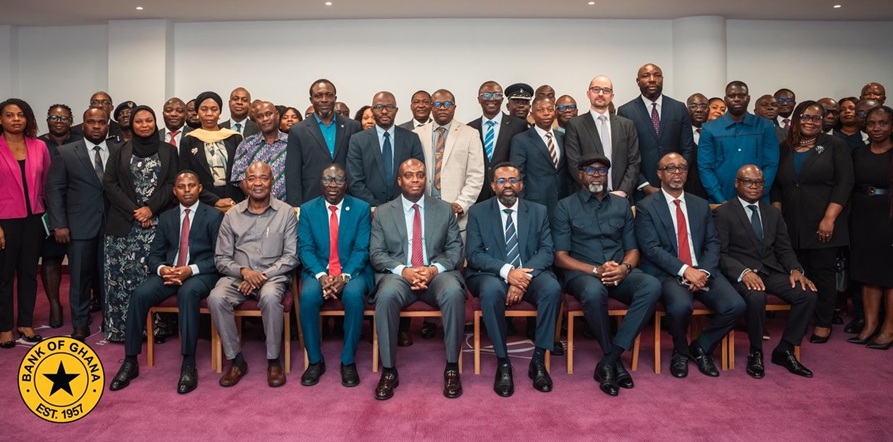
Law enforcement agencies, supervisors, regulators, prosecutors, and other competent authorities have deepened collaboration, improved the use of financial intelligence, and sharpened their focus on outcomes—investigations, prosecutions, convictions, and asset recovery.
Most importantly, AML/CFT is no longer viewed as a narrow technical obligation of a few institutions.
It is now recognised as a national responsibility—one that safeguards our financial system, protects our economy, preserves investor confidence, and upholds Ghana’s standing in the global community.
We approach this Mutual Evaluation with confidence and humility. We acknowledge that challenges remain. No system is ever complete, and no country is immune to evolving risks.
However, Ghana has built a framework that is credible, responsive, and anchored in sustained political commitment.
This exercise is therefore not an examination we fear, but a partnership we welcome. Your observations will help us refine our systems, strengthen effectiveness, and align more closely with international best practices.
Ghana’s commitment to combating money laundering, terrorist financing, and proliferation financing is unwavering. It is a commitment rooted not only in international standards, but in our national interest and our responsibility to future generations.
As you engage with our institutions over the coming days, we encourage open dialogue, constructive scrutiny, and candid exchange. You will find partners who are prepared, transparent, and determined to continue improving.
We trust that your engagement will be productive and reflective of the strong cooperation between Ghana, GIABA, and the global AML/CFT community.
On behalf of the Government and People of the Republic of Ghana, I welcome you to Accra and to this critical phase of our collective journey—the on-site Mutual Evaluation of Ghana’s Anti-Money Laundering, Counter-Terrorist Financing, and Counter-Proliferation Financing (AML/CFT/CPF) regime.
This moment is not merely procedural. It represents a time of truth, reflection, and accountability. It offers Ghana the opportunity to demonstrate commitment over perfection, implementation over theory, and impact over intention.
Ghana has deliberately chosen the path of reform, realism, and results. The National Risk Assessment was not treated as a shelf document, but as a diagnostic tool that compelled us to confront vulnerabilities honestly—across sectors, products, institutions, and borders. From this process emerged difficult but necessary conversations, policy recalibrations, institutional reforms, and renewed political will.
We have strengthened coordination at the highest level through the Inter-Ministerial Committee on AML/CFT. We have enhanced the operational independence and analytical capacity of the Financial Intelligence Centre.
Law enforcement agencies, supervisors, regulators, prosecutors, and other competent authorities have deepened collaboration, improved the use of financial intelligence, and sharpened their focus on outcomes—investigations, prosecutions, convictions, and asset recovery.
Most importantly, AML/CFT is no longer viewed as a narrow technical obligation of a few institutions.
It is now recognised as a national responsibility—one that safeguards our financial system, protects our economy, preserves investor confidence, and upholds Ghana’s standing in the global community.
We approach this Mutual Evaluation with confidence and humility. We acknowledge that challenges remain. No system is ever complete, and no country is immune to evolving risks.
However, Ghana has built a framework that is credible, responsive, and anchored in sustained political commitment.
This exercise is therefore not an examination we fear, but a partnership we welcome. Your observations will help us refine our systems, strengthen effectiveness, and align more closely with international best practices.
Ghana’s commitment to combating money laundering, terrorist financing, and proliferation financing is unwavering. It is a commitment rooted not only in international standards, but in our national interest and our responsibility to future generations.
As you engage with our institutions over the coming days, we encourage open dialogue, constructive scrutiny, and candid exchange. You will find partners who are prepared, transparent, and determined to continue improving.
We trust that your engagement will be productive and reflective of the strong cooperation between Ghana, GIABA, and the global AML/CFT community.